

Your driveway is failing. Here’s how to fix it properly.
Most driveway problems don’t start at the surface. They start underneath it.
That crack in your tarmac? Probably water getting into a weak sub-base. Those blocks sinking where the tyres sit? The foundation wasn’t compacted properly when it was first laid. Gravel ending up on the pavement, in the porch, stuck in the soles of your shoes? That’s just what gravel does.
Homeowners often spend years patching these problems. A bag of gravel here, a re-levelled block there, some weed killer along the edges. It works for a while. Then the same issues come back, usually worse than before, because nothing was done about the cause.
At some point, the question stops being “How do I fix this?” and becomes “Should I just replace the whole thing?”
If you’re at that point, this is worth reading before you decide what to replace it with.
What’s actually going wrong with your driveway
Four things kill driveways:
- A sub-base that was never done properly in the first place
- Water finding its way into the surface and sitting there
- Vehicle movement grinding down weak spots over time
- Years of frost, rain, UV and organic growth doing what nature does
Once the base fails, surface repairs are temporary. You can keep patching, but you’re spending money on something that will need doing again in twelve months. If the structure underneath isn’t sound, the surface on top doesn’t matter.
That’s worth remembering when you’re comparing upgrade options, because the cheapest surface on a good base will outperform an expensive surface on a bad one every time.
Gravel: cheap upfront, expensive in patience
Gravel driveways are popular because they’re affordable and quick to lay. For rural properties with long drives and informal layouts, they work well enough.
For everyone else, gravel tends to become a long-running frustration.
The stones migrate. They end up on the lawn, the pavement, the road, and eventually in your hallway carpet. Ruts form where the car parks. Weeds colonise the surface within a season. Pushing a bin or a buggy across loose gravel is genuinely annoying. And after heavy rain, you’ll find bare patches where the stones have washed into low spots.
The maintenance never really stops. You’re topping up, raking, weeding, and re-levelling on a rolling basis. None of it is expensive individually, but it adds up across years, both in cost and in time you’d rather spend doing something else.
If what you actually like about gravel is the natural stone appearance, that’s worth noting. You can get that look without the loose surface. Resin bound aggregate uses similar natural stones, but they’re fixed in place with a clear resin binder. Same aesthetic, none of the spreading. More on that further down.
Block paving: looks smart until the joints give up
Block paving has been the default “nice driveway” option in the UK for decades. Herringbone patterns, red and charcoal mixes, neat soldier course borders. When it’s freshly laid on a solid base, it looks genuinely good.
The problem is the joints.
Sand washes out. Weeds move in. Ants build nests between the blocks. Moss covers the shaded areas. You pressure wash it, which removes more sand, which opens up bigger gaps, which lets in more weeds. It’s a cycle that only gets worse.
Then there’s the structural side. Blocks rely on the base and edge restraints to stay put. If either fails, blocks start sinking, usually in the wheel tracks first. Once a few go, the rest follow because the interlocking pattern loses its tension.
You can lift and re-lay individual blocks, which is one genuine advantage over other materials. But if you’re re-laying large sections, you’re essentially rebuilding the driveway anyway.
Block paving suits homeowners who like the traditional patterned look and don’t mind the ongoing upkeep. If that’s you, it’s still a solid option when installed properly. If you’re tired of the maintenance cycle, it might be time for something different.
Tarmac: functional, nothing more
Tarmac does the job. It gives you a flat, smooth surface that handles vehicles well. It’s relatively affordable, quick to install, and you don’t need to think about it much for the first few years.
After that, the cracks arrive. Then the weeds. Then the fading. Then the edges start crumbling. Oil stains become permanent features. In hot summers, the surface goes soft enough to mark with a heel.
The real issue with tarmac is that it looks like a small car park. For some properties, that’s fine. Function over form. But if kerb appeal matters to you at all, tarmac won’t deliver it.
One thing tarmac does well is serve as a base for other surfaces. If your existing tarmac is structurally sound but just looks tired, it may be possible to overlay it with a decorative finish rather than ripping it out entirely. That can save a significant amount on groundwork costs.
Resin bound: what it actually is (and isn’t)
Resin bound surfacing has grown steadily in the UK over the last decade, and there’s a reason it keeps coming up when homeowners look at driveway upgrades. It solves most of the complaints people have about the materials above.
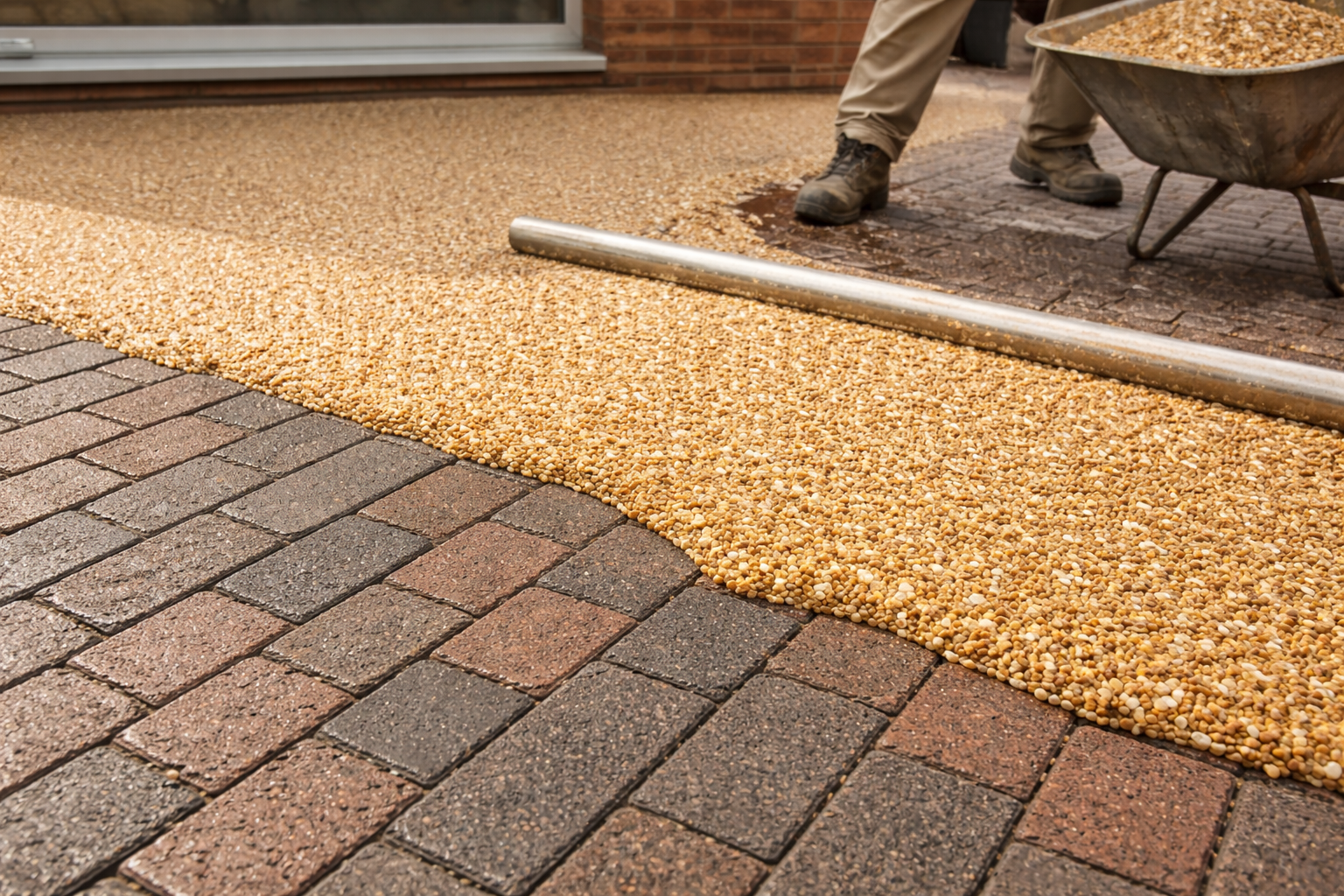
The process is straightforward. Natural stone aggregate, similar to the kind you’d see in a good gravel, gets mixed with a clear UV-stable resin and hand-trowelled onto a prepared base. The result is a smooth, seamless stone surface where every aggregate piece is locked in place.
No loose stones. No joints for weeds. No cracking in frost (the resin has some flex to it). No puddles, because the surface is permeable when laid on the right base. And the colour doesn’t fade, because the resin is UV-stable and the aggregate is natural stone that doesn’t change over time.
The maintenance is about as simple as it gets. Sweep it occasionally. Rinse it with a hose if it gets dirty. That’s more or less it.
It does cost more upfront than gravel or tarmac. For an average-sized driveway, expect somewhere between £4,500 and £8,500 depending on the size, access, and how much base preparation is needed. That’s a meaningful amount of money and there’s no point pretending it isn’t.
What changes the calculation is how long it lasts. A properly installed resin bound driveway should give you 15 to 25 years with barely any upkeep. Stack that against fifteen years of topping up gravel, or the cost of lifting and re-laying block paving every few years when the joints fail again, and the gap narrows considerably.
The other thing to be upfront about: resin bound is not a DIY job. The mixing ratios, laying speed, temperature sensitivity and trowelling technique all matter. Poor installation leads to loose stones, inconsistent finish, and a surface that fails within a couple of years. This is specialist work, and the quality of the installer makes an enormous difference to the outcome.
Resin bound is only as good as what’s underneath it
This is the point that gets glossed over in a lot of driveway marketing, so it’s worth spelling out clearly.
You cannot lay resin bound onto an unstable base and expect it to perform.
If your existing driveway has sinking blocks, major cracks, soft spots, standing water, or tree root movement, those problems need solving before any new surface goes on top. Resin bound won’t fix a bad foundation. Nothing will.
In some cases, the existing surface is sound enough to serve as a base after cleaning and preparation. Stable tarmac or solid concrete can often be overlaid directly, which saves on groundwork. In other cases, the old driveway needs to come out and a proper new base needs building.
A decent installer will tell you this at the survey stage. They’ll assess what’s there, explain what needs doing, and quote accordingly. Be wary of anyone who’s willing to lay resin straight onto whatever exists without checking first. That’s how you end up with a beautiful surface that starts cracking six months later.
Choosing the right colour
One thing resin bound does well is colour choice. Because you’re working with natural stone aggregates, the options are broad and the finishes look genuinely natural rather than artificial.
A few guidelines that tend to work:
Grey blends suit modern rendered properties and contemporary architecture. They give a clean, minimal feel that works with pale walls and dark window frames.
Warm golds, honeys, and toffee tones complement red brick, buff brick, and period properties. They age well and feel welcoming rather than stark.
Lighter mixes can brighten up shaded or north-facing driveways. Darker blends create a more premium, defined look that works well with contrast edging.
Mixed natural stone colours are worth considering for larger driveways where a single uniform tone might look flat. The slight variation in shade across the aggregate adds depth.
The most common mistake people make is choosing a colour from a small sample chip without seeing it at scale. What looks perfect in a 10cm square can look completely different across 60 square metres. Ask to see completed projects in a similar colour before committing. Any reputable installer will have a portfolio to show you.
For Kola Construction’s full colour range, have a look at the resin bound colours page.
Looking after a resin bound surface
Low maintenance is not the same as no maintenance. Resin bound driveways need some basic care to stay looking their best.
The main thing is keeping organic matter off the surface. Leaves sitting on it for weeks in autumn can stain and encourage algae in damp conditions. A regular sweep sorts that out. Oil or fuel spills should be wiped up quickly rather than left to soak in, and a periodic rinse with a garden hose or gentle pressure wash keeps things looking fresh. Avoid blasting one spot with an industrial pressure washer at close range, though, as concentrated high pressure can dislodge aggregate.
The only other thing to watch is soil creeping over the edges from planting beds. Border plants are fine, but soil washing onto the resin creates patches where moss eventually takes hold.
That’s genuinely it. If you’ve spent years re-sanding block paving joints and pulling weeds out of gravel, you’ll find the difference remarkable.
For detailed aftercare guidance, read the resin bound maintenance guide.
How to decide what’s right for your driveway
Forget decision matrices and flowcharts. Start with what actually bothers you about your current driveway. If it’s the maintenance, resin bound or well-laid tarmac will both reduce your workload. If it’s the appearance, resin bound or quality block paving will improve kerb appeal. If nothing bothers you except the cost of doing anything at all, gravel with proper edging might be the pragmatic choice. If you’re looking at the wider front of the house, options like porcelain paving or natural stone can work well for paths and borders alongside a new driveway surface.
Kola Construction covers the full range of driveway and patio solutions, so a survey can assess what combination makes sense for your property rather than forcing everything into one material.
Then think about budget realistically, and remember that the surface is only part of the cost. If your existing base is failing, the groundwork to fix it will be a chunk of the total spend regardless of what goes on top. Get a proper survey before committing.
The other thing worth considering is how long you plan to stay. Investing in a 20-year surface makes obvious sense if you’ll be there to enjoy it. If you’re selling within a year, the numbers work differently.
See what the finished result looks like
Before committing to any driveway upgrade, look at completed projects on real properties. Not CGI renders, not stock photos, not AI-generated mockups. Actual finished driveways on actual houses.
Kola Construction has completed resin bound projects across Dorset, Hampshire, Berkshire, Maidenhead, Surrey, London, and Essex. You can see examples of real before-and-after transformations in the case studies.
If your driveway has loose gravel, sinking blocks, or cracked tarmac and you want to find out whether resin bound would work on your property, the best next step is a site assessment. Kola Construction will look at the existing surface, check the base, discuss your options, and give you an honest answer about what’s needed.
Get in touch through the contact page or call 0800 038 5746.
No one can tell you whether resin bound is right for your driveway from a photo or a phone call. But a 20-minute site visit will give you a clear answer, and there’s no obligation attached to it.
The same surface works equally well for patios and paths, so if you’re thinking about the back garden too, it’s worth mentioning at the survey stage. You can browse all locations Kola Construction covers and read customer testimonials from completed projects.
Common questions
Can resin bound go over old tarmac or block paving? Over tarmac, sometimes. If it’s structurally sound and stable, it can work as a base after preparation. Over block paving, only if the blocks aren’t moving. Sinking or loose blocks usually need removing or the base rebuilding first. In both cases, the only way to know is a site assessment. <!– INTERNAL LINK NEEDED: The original blog linked to /can-resin-bound-be-laid-over-block-paving/ but this URL is not in the page sitemap. Confirm whether this page/post exists before publishing, and add the link here if live. –>
Is resin bound actually better than gravel? For a clean finish that doesn’t require constant attention, yes. Gravel is cheaper to install but creates ongoing work and mess. Resin bound keeps the natural stone look without loose surfaces. Whether it’s the right choice for you depends on budget, property style, and how much the gravel’s current behaviour actually bothers you.
What about weeds? A properly installed resin bound surface removes the joints and gaps where weeds take hold, so the problem drops dramatically compared to block paving or gravel. Seeds can still land on the surface and germinate in accumulated dirt, so you’ll need to sweep and clean occasionally. But you won’t be on your knees pulling weeds out of joints every other weekend.
How do I choose the right colour? Match it to the house, not to what catches your eye on a sample board. Colours look different at scale. View completed projects in similar finishes before deciding. Start with the resin bound colours page and ask to see larger samples or real installations.